
What Actually Affects Speaker Sound Quality?
Introduction: What Truly Determines Speaker Performance
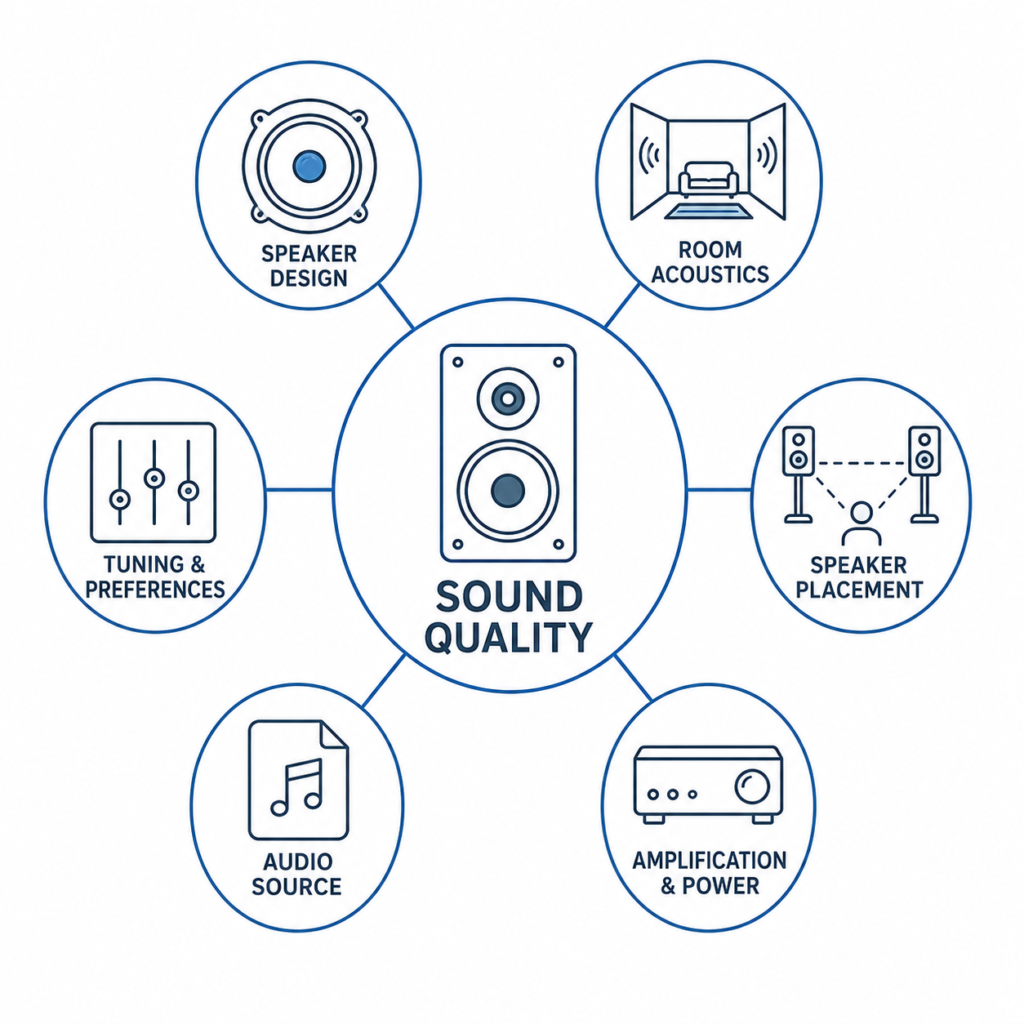
When people talk about speaker sound quality, the conversation often focuses on the wrong things. Many buyers assume louder speakers automatically sound better, bigger speakers always outperform smaller ones, or expensive brands guarantee superior audio. In reality, speaker sound quality depends on a combination of engineering, acoustics, tuning, placement, and listening preferences rather than a single specification or marketing claim.
Understanding what affects speaker sound quality requires looking at the entire audio chain. The speakers themselves matter, but so do the room, the positioning, the source quality, and the way the system is tuned. A well-placed mid-range speaker setup in a properly treated room can easily outperform a much more expensive system used poorly.
This guide breaks down the real speaker audio quality factors that actually influence what you hear. From speaker drivers and frequency response to room acoustics and Bluetooth codecs, we will separate measurable improvements from common myths so you can better understand how speaker quality works and what truly makes a speaker sound good.
If you are shopping for portable audio specifically, our complete Bluetooth speaker buying guide explains how size, tuning, battery life, and portability affect real-world performance.
Find more expert advice in our Audio Gadgets resource center.
Speaker Design and Hardware Fundamentals
Drivers and Sound Production
Speaker drivers are the core components responsible for producing sound. Every sound you hear from a speaker comes from physical movement created by these drivers pushing air toward the listener. The quality of the driver design plays one of the biggest roles in determining speaker clarity, bass response, detail retrieval, and distortion levels.
Tweeters, Woofers, and Subwoofers Explained
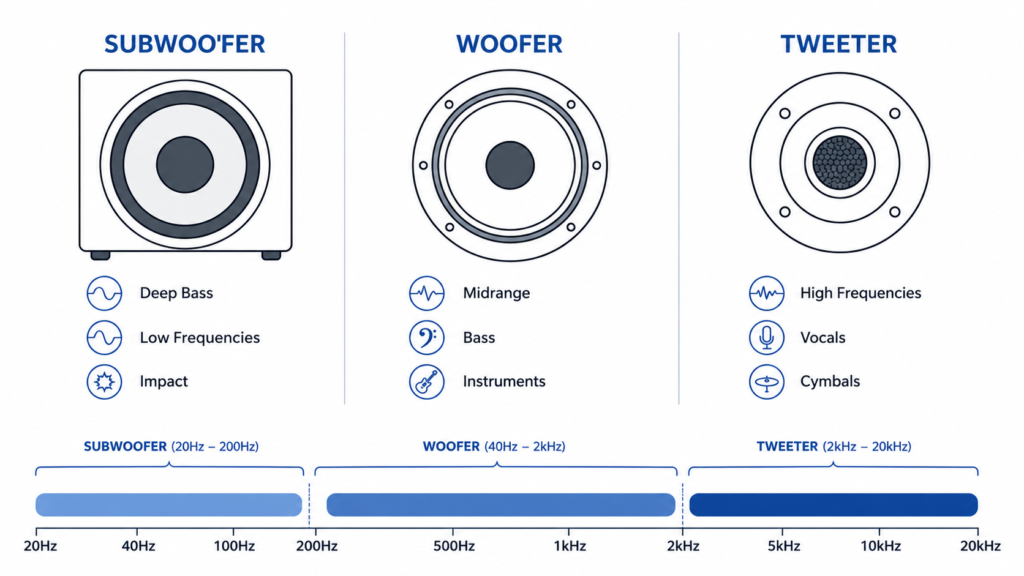
Different drivers are optimized for different frequency ranges.
- Tweeters handle high frequencies such as vocals, cymbals, and treble details
- Woofers reproduce midrange and bass frequencies
- Subwoofers focus on deep low-end bass
Separating frequencies across multiple drivers allows speakers to reproduce sound more accurately and efficiently. Small tweeters respond quickly and handle detailed treble better, while larger woofers move more air to produce stronger bass output.
How Driver Size and Materials Influence Sound
Driver size affects how a speaker behaves across frequencies. Larger drivers generally produce fuller bass because they can move more air, while smaller drivers often provide tighter and faster response.
However, bigger does not automatically mean better. A poorly tuned large driver can sound muddy, while a high-quality smaller driver may sound cleaner and more controlled.
Driver materials also matter. Common materials include:
- Paper cones for natural tonal balance
- Aluminum for rigidity and detail
- Polypropylene for durability
- Kevlar or carbon fiber for reduced distortion
Each material changes how the driver flexes, vibrates, and responds under movement.
Do More Drivers Always Improve Performance?
Not necessarily.
Some marketing focuses heavily on driver count, but more drivers do not automatically improve sound quality. A properly engineered two-driver speaker can outperform a poorly designed multi-driver system.
What matters more is:
- crossover quality
- driver integration
- cabinet tuning
- overall speaker design
Poorly integrated drivers can create phase issues, uneven frequency response, or inconsistent imaging.
Enclosure Design and Its Impact
The cabinet surrounding the drivers has a major influence on how a speaker sounds. Enclosure design affects resonance, bass response, tonal balance, and clarity.
Why Cabinet Design Matters
When a speaker driver moves, it creates energy inside the enclosure as well as outside. A weak or poorly constructed cabinet can vibrate and color the sound, reducing clarity and accuracy.
Higher-quality cabinets reduce unwanted resonance and help maintain cleaner sound reproduction.
Sealed vs Ported Speakers
Sealed speakers use enclosed cabinets with no airflow vents. They often produce tighter and more controlled bass with smoother roll-off characteristics.
Ported speakers include vents or ports that increase efficiency and bass output. These designs can sound more powerful in the low frequencies but sometimes sacrifice precision depending on the tuning.
Neither approach is universally better. Sealed designs are often preferred for accuracy, while ported systems are popular for stronger bass impact and higher output efficiency.
The Effect of Cabinet Materials on Sound Quality
Cabinet material influences rigidity and resonance control.
MDF is commonly used because it balances density, affordability, and vibration control. Plastic cabinets are lighter and cheaper but can flex more easily, especially at higher volumes.
This is one reason why inexpensive portable speakers often struggle with clarity and bass control compared to larger stationary systems.
Crossovers and Frequency Management
Crossovers are internal components that divide frequencies between drivers. Without crossovers, every driver would attempt to reproduce the entire audio spectrum, resulting in distortion and poor efficiency.
What a Crossover Does Inside a Speaker
A crossover sends:
- highs to tweeters
- mids and bass to woofers
- deep bass to subwoofers
This allows each driver to focus on frequencies it is specifically designed to reproduce.
How Crossover Design Affects Clarity and Balance
Well-designed crossovers help speakers sound smooth and cohesive. Poor crossover tuning can create harsh highs, recessed mids, or uneven transitions between drivers.
Many high-end speakers invest heavily in crossover engineering because it directly affects imaging, tonal balance, and overall listening experience.
These differences become especially apparent when comparing portable vs home speakers, as larger home speaker systems often have more cabinet space and driver configurations that allow for wider soundstage and stronger stereo imaging.
Frequency Response and Sound Signature
Understanding Frequency Response
Frequency response describes how evenly a speaker reproduces different frequencies across the audible spectrum.
A flatter frequency response usually indicates more neutral and accurate sound reproduction. This is why studio monitors often aim for relatively flat tuning.
However, flat does not always mean more enjoyable. Many consumers prefer speakers with boosted bass or treble because they sound more energetic and exciting.
Why Flat Response Is Often Preferred
Flat tuning reproduces music closer to how it was originally mixed. It generally provides:
- better balance
- clearer mids
- more natural vocals
- less exaggerated bass or treble
For critical listening and production work, flatter speakers are often preferred because they reveal more detail and accuracy.
Colored Sound vs Neutral Sound
Not all speakers aim for neutral sound. Many intentionally shape their tuning profile to create a specific listening experience.
Common sound signatures include:
- Bright: emphasized treble and detail
- Warm: boosted mids and bass
- V-shaped: enhanced bass and treble with recessed mids
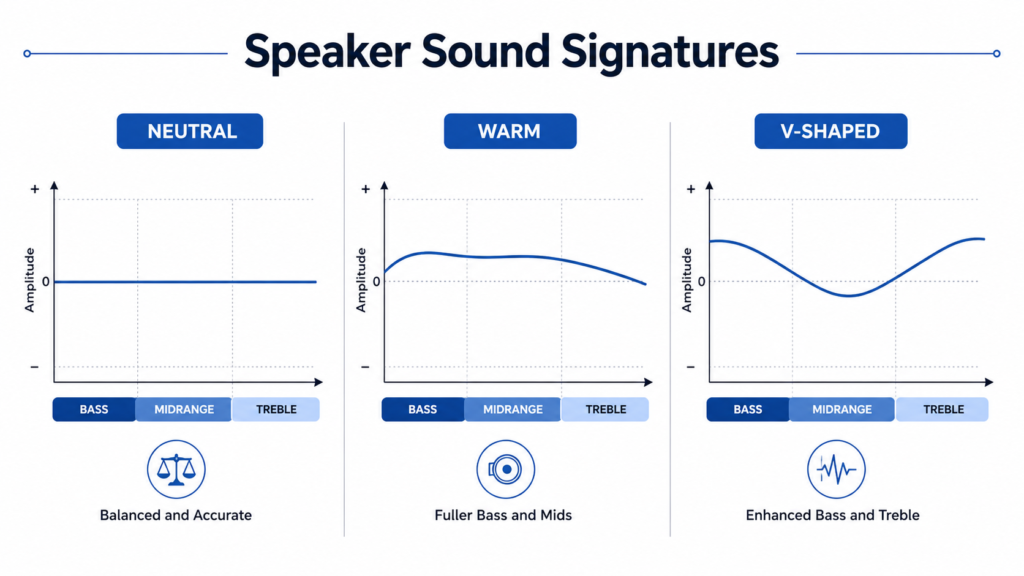
Different listeners prefer different tuning styles depending on the type of music they enjoy.
Bass-heavy tuning may work well for electronic music or hip-hop, while balanced tuning often suits acoustic music, jazz, or vocals better.
When Coloration Is Desirable
Coloration is not automatically bad. Some speakers intentionally add warmth or excitement because it makes music more enjoyable for casual listening.
This is one reason why two highly rated speakers can sound completely different while both still being considered excellent.
Does a Wider Frequency Range Matter?
Many speaker marketing claims advertise extremely wide frequency ranges, but these numbers can be misleading.
Human hearing typically ranges from about 20Hz to 20kHz. Frequencies outside this range usually provide little practical benefit for most listeners.
More importantly, advertised frequency response rarely tells you how accurately those frequencies are reproduced. A speaker that claims 20Hz–40kHz may still sound worse than a speaker with a narrower but more balanced response.
Source Quality and the Audio Chain
Audio Source Quality
Even excellent speakers cannot fully compensate for poor source audio.
Lossy vs Lossless Audio Formats
Lossy formats like MP3 compress audio by removing data to reduce file size. Higher compression levels often reduce detail, clarity, and dynamic range.
Lossless formats preserve more information and generally provide cleaner playback, especially on higher-end equipment.
Streaming services also vary significantly in quality depending on bitrate settings and compression methods.
Streaming Quality and Compression Impact
Bluetooth streaming introduces additional compression depending on the codec being used. Lower-quality codecs can reduce detail and introduce artifacts.
Our Bluetooth codec comparison guide explains how SBC, AAC, aptX, and LDAC affect wireless audio quality and why codec support matters for Bluetooth speaker performance.
Digital-to-Analog Conversion (DAC)
Every digital audio device uses a DAC to convert digital signals into analog sound.
What a DAC Does
Phones, laptops, TVs, and streaming devices all contain built-in DACs. Dedicated DACs can improve noise performance, signal accuracy, and clarity in higher-end systems.
When a DAC Upgrade Makes a Difference
For most casual listeners, speaker quality and room acoustics matter far more than DAC upgrades. However, on revealing equipment, poor DAC performance can introduce noise, distortion, or reduced detail.
DAC upgrades tend to matter most in higher-end systems where the rest of the equipment is already strong.
Amplification and Power
Amplification provides the electrical power needed to drive speakers properly.
Why Amplification Matters
Weak amplification can cause distortion, compression, or loss of dynamics at higher listening levels. A good amplifier delivers clean power consistently without clipping.
Power, Headroom, and Distortion
Headroom refers to extra amplifier capacity available during dynamic peaks. Systems with adequate headroom sound cleaner and less strained during loud passages.
This is why quality amplification often sounds smoother even when volume levels are moderate.
Understanding Impedance Matching
Speakers and amplifiers must work together properly. Mismatched impedance can reduce efficiency or place unnecessary strain on equipment.
Most modern consumer systems handle this automatically, but proper matching still matters in higher-performance setups.
Room Acoustics: The Biggest Overlooked Factor
Many people underestimate how dramatically rooms affect speaker performance. In reality, room acoustics and speakers are deeply connected.
A mediocre speaker in a good room can sound impressive, while an expensive speaker in a poor room can sound disappointing.
How Rooms Shape Sound
Sound interacts with walls, ceilings, floors, furniture, and every surface inside a room. Reflections and reverberation alter tonal balance, imaging, and perceived clarity.
The Influence of Room Size and Layout
Small rooms often exaggerate bass frequencies and create uneven response due to standing waves. Large open rooms may reduce bass impact and make speakers sound thinner.
Room shape also affects how sound reflects and disperses.
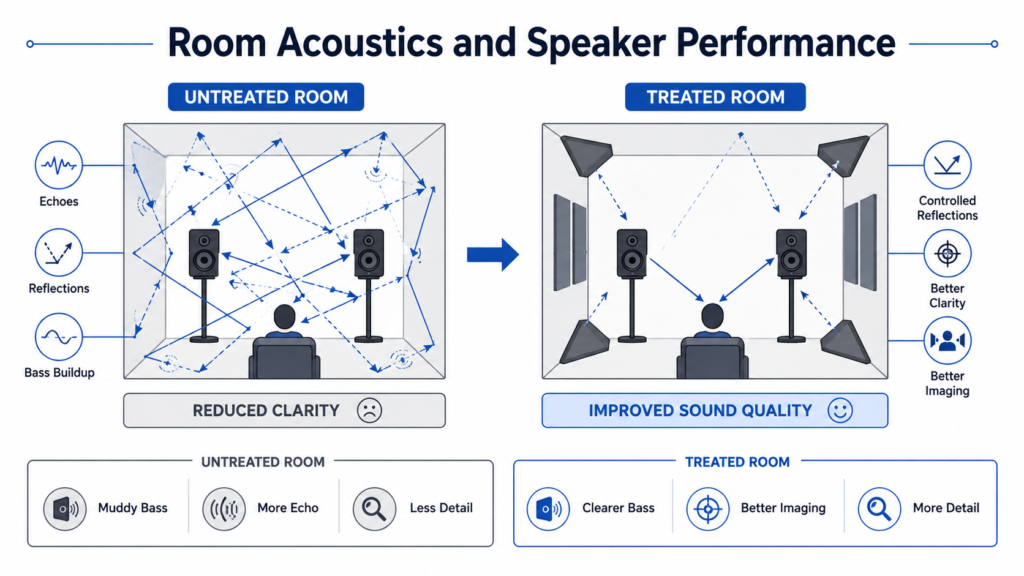
Why Untreated Rooms Degrade Performance
Hard reflective surfaces create echoes and harsh reflections that smear detail and reduce stereo imaging precision.
This is why untreated rooms often sound:
- boomy
- harsh
- hollow
- muddy
Reflections, Echo, and Standing Waves
How Sound Interacts with Surfaces
Sound waves bounce repeatedly throughout a room before reaching your ears. These reflections combine with direct sound and alter what you hear.
Common Acoustic Problems
Common room issues include:
- excessive bass buildup
- flutter echo
- uneven frequency response
- weak center imaging
Many of these problems become worse as speaker volume increases.
Improving Acoustics with Simple Changes
You do not always need professional acoustic panels to improve sound quality.
Rugs, Curtains, and Furniture Placement
Soft materials help absorb reflections naturally. Rugs, curtains, couches, and bookshelves can all improve room acoustics.
Acoustic Treatment Basics
Dedicated treatment panels and bass traps provide even more control over reflections and low-frequency buildup.
For many systems, improving room acoustics creates a larger improvement than upgrading electronics.
Speaker Placement and Positioning
Speaker placement is one of the highest-impact adjustments you can make without spending additional money.
The Foundations of Proper Placement
Finding the Ideal Listening Position
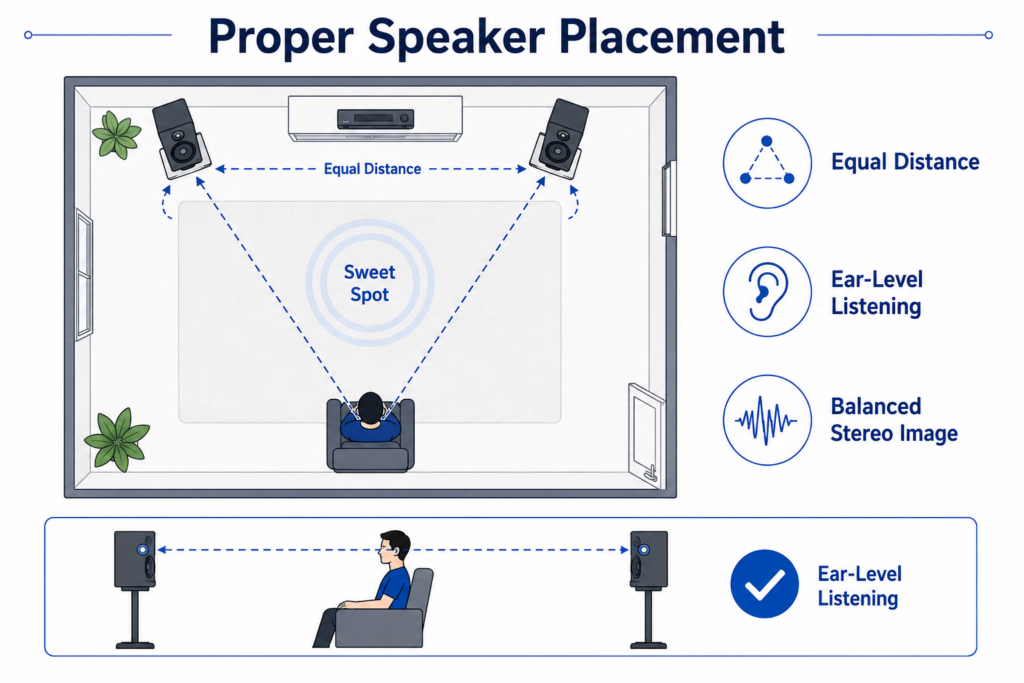
Stereo systems usually perform best when speakers and the listener form an equilateral triangle.
This helps create accurate stereo imaging and balanced soundstage presentation.
Speaker Spacing and Distance
Speakers placed too close together reduce soundstage width. Too much spacing can create a disconnected center image.
Distance from walls also affects bass response. Placing speakers too close to walls often exaggerates low frequencies.
Fine-Tuning for Better Imaging
Toe-In and Speaker Angle
Angling speakers slightly toward the listener often improves clarity and center imaging.
Height and Ear-Level Alignment
Tweeters typically sound best near ear level because high frequencies are directional.
What Is the “Sweet Spot”?
The sweet spot is the listening position where stereo imaging and tonal balance sound most accurate and immersive.
Small placement adjustments can dramatically change how speakers sound.
Listening Levels and Volume Effects
Perception of Sound at Different Volumes
Humans naturally perceive louder sound as fuller and more exciting.
Why Louder Can Sound Better at First
Increased volume often creates the impression of:
- deeper bass
- stronger detail
- greater clarity
However, louder playback does not always mean higher sound quality.
Distortion and Performance Limits
As speakers approach their limits, distortion increases.
What Happens at High Volume Levels
At excessive volume levels:
- bass becomes muddy
- treble becomes harsh
- compression increases
- clarity decreases
Smaller speakers struggle more at higher output levels because their drivers have less physical capability.
How to Avoid Damaging Sound Quality
Using speakers within their intended performance range preserves cleaner sound and reduces distortion.
Cables and Connections: What Actually Matters
Speaker cables are one of the most overhyped areas in audio.
Separating Myths from Measurable Differences
Do Expensive Cables Improve Sound?
In most setups, expensive cables produce little to no audible improvement.
Reliable construction and proper gauge matter more than luxury branding.
Cable Thickness and Resistance
Longer cable runs benefit from thicker wire because resistance increases over distance.
Connector Quality and Durability
Well-built connectors improve reliability and longevity, though they rarely transform sound quality by themselves.
Wireless vs Wired Audio Performance
Bluetooth Audio Limitations
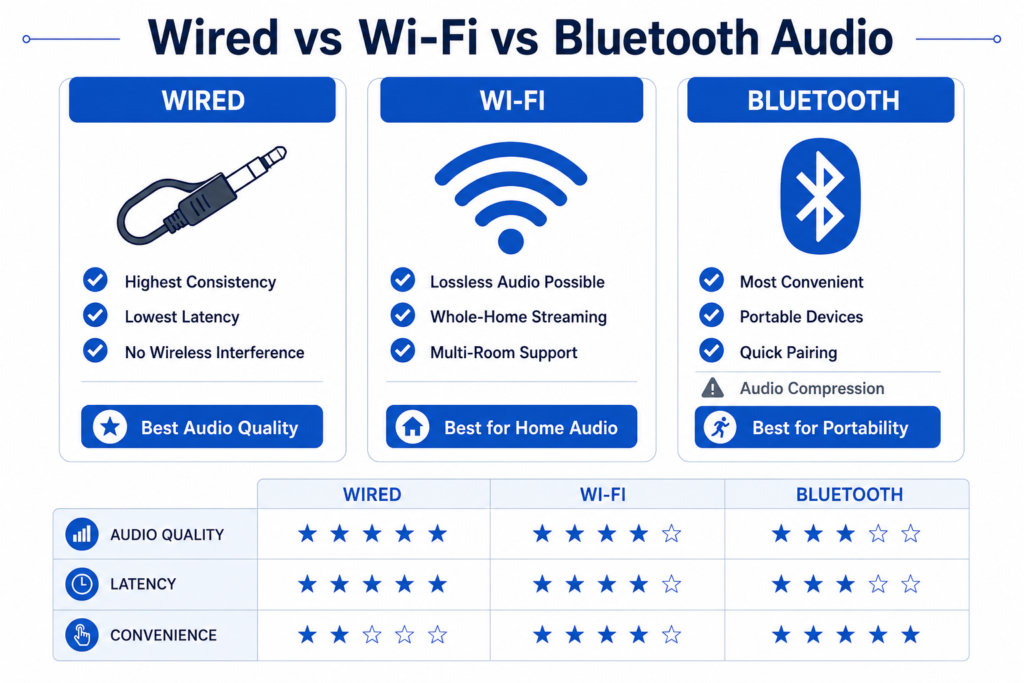
Bluetooth audio uses compression to transmit sound wirelessly.
Compression and Signal Loss
Lower-quality Bluetooth codecs can reduce detail and dynamic range compared to wired playback.
Understanding Codecs
Modern codecs like AAC, aptX, and LDAC preserve more detail than older SBC implementations.
Codec quality plays a major role in Bluetooth speaker sound quality, especially at higher listening levels.
Wi-Fi Audio and Lossless Streaming
Wi-Fi audio systems support significantly more bandwidth than Bluetooth.
Because of this, some wireless systems can stream lossless audio with extremely high quality.
Modern wireless audio can sound remarkably close to wired playback when implemented correctly.
Sound Preferences and Music Genres
Why Different Speakers Suit Different Genres
Different music styles benefit from different tuning approaches.
Bass-heavy speakers may suit:
- hip-hop
- EDM
- movies
More balanced speakers may perform better for:
- vocals
- jazz
- acoustic recordings
- classical music
Objective Accuracy vs Personal Taste
Speaker sound quality is partly subjective.
Some listeners prioritize accuracy and neutrality, while others prefer warmth, bass emphasis, or energetic treble.
This is why “better” is not always universal.
Understanding Speaker Specifications
Specs That Actually Matter
The most useful speaker specifications include:
- frequency response
- sensitivity
- impedance
- distortion levels
Frequency Response
This helps describe tonal balance and extension.
Sensitivity
Sensitivity determines how efficiently speakers convert power into volume.
Impedance
Impedance affects amplifier compatibility and efficiency.
Total Harmonic Distortion (THD)
Lower distortion generally means cleaner playback.
Misleading or Overhyped Specs
Peak Power vs RMS Ratings
Peak power ratings are often inflated marketing numbers. RMS ratings are usually more meaningful.
For a deeper look at RMS vs peak power, loudness, and what wattage actually tells you, see our Bluetooth speaker wattage explained guide.
Marketing Terminology to Ignore
Terms like:
- “audiophile-grade”
- “premium sound”
- “studio quality”
often provide little measurable information.
Speaker Break-In: Myth or Reality?
Some enthusiasts believe speakers dramatically improve after extended use.
Small mechanical changes may occur as driver suspensions loosen slightly, but dramatic transformations are often exaggerated.
In many cases, listeners simply become accustomed to the speaker’s tuning over time.
Measurements vs Listening Experience
Measurements help evaluate speaker performance objectively, but they do not fully predict listening enjoyment.
Two speakers with similar measurements can still sound very different because of:
- tuning choices
- crossover behavior
- cabinet resonance
- psychoacoustics
Objective data matters, but listening experience still plays an important role.
Price vs Performance
Understanding Diminishing Returns
Higher prices can improve sound quality, but improvements become smaller at higher price tiers.
A good mid-range speaker often delivers better value than extremely expensive systems.
Building the Best System on a Budget
For most people, the biggest improvements come from:
- better speakers
- smarter placement
- improved acoustics
- cleaner source audio
If you are shopping on a tighter budget, our budget Bluetooth speaker rankings under $50 focus on practical sound quality and value instead of inflated marketing claims.
Buyers wanting stronger performance and fuller sound should also compare our Bluetooth speakers under $100 guide, which covers larger drivers, improved tuning, and stronger overall audio quality.
Choosing Speakers for Different Use Cases
Matching Speakers to Your Needs
Different environments require different speaker priorities.
Home Theater Setups
Home theater systems prioritize immersion, bass impact, and cinematic presentation.
Music Listening Systems
Music-focused systems emphasize detail, imaging, and tonal balance.
Gaming and Desktop Setups
Gaming systems benefit from accurate positioning and controlled near-field performance.
Office and Casual Listening
Casual listening setups often prioritize convenience, compactness, and easy placement.
For larger rooms or dedicated listening setups, our stationary speaker recommendations for home audio explore systems designed for stronger room-filling sound and deeper bass extension.
Should You Optimize for One Use or Many?
Multi-purpose systems always involve some compromise.
Optimizing around your primary listening habits usually produces the best long-term satisfaction.
Calibration and System Optimization
Using EQ to Shape Sound
Equalization adjusts frequency balance to compensate for room issues or personal preferences.
Small EQ changes can dramatically improve clarity and tonal balance.
Room Correction Systems
Systems like Audyssey and Dirac automatically analyze room acoustics and adjust speaker output to improve performance.
These tools can significantly improve bass consistency and imaging.
Can Tuning Fix Poor Equipment?
EQ and calibration can improve sound considerably, but they cannot fully overcome poor speaker design.
Starting with quality speakers still matters most.
Common Speaker Myths Debunked
Several audio myths continue to confuse buyers:
- More watts does not automatically mean better sound
- Bigger speakers are not always superior
- Expensive gear does not guarantee quality
- Brand reputation alone does not determine performance
Modern engineering and tuning matter far more than marketing claims or legacy reputation.
Listeners interested in premium-tier performance can also compare our high-end Bluetooth speaker picks to see where spending more genuinely improves sound quality and where diminishing returns begin.
Key Takeaways: What Matters Most
The Biggest Factors That Impact Sound Quality
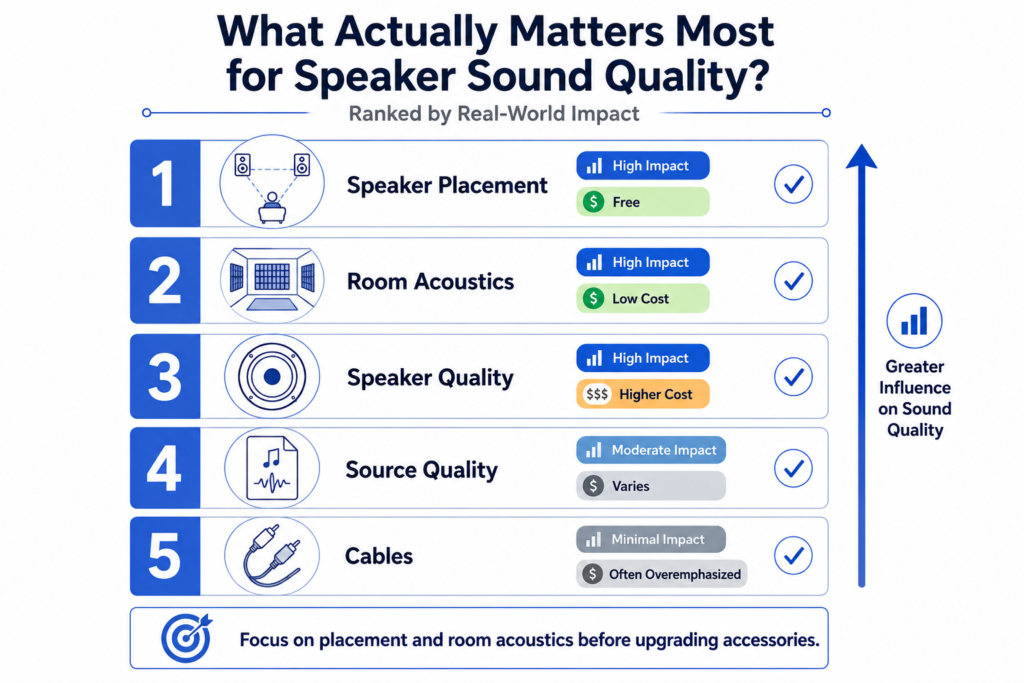
The three biggest factors are:
- Speaker placement and positioning
- Room acoustics
- Speaker quality and tuning
These influence performance far more than expensive accessories or inflated specifications.
Where Beginners Should Focus First
Before upgrading electronics, focus on:
- speaker placement
- room reflections
- source quality
- listening position
These adjustments often create surprisingly large improvements for little or no cost.
High-Impact Upgrades That Actually Work
The most effective upgrades usually include:
- better speakers
- room treatment
- improved placement
- cleaner audio sources
These changes consistently produce larger improvements than chasing expensive cables or exaggerated power ratings.
Final Thoughts: If You Only Change Three Things
If you only improve three areas of your audio setup, focus on:
- Speaker placement
- Room acoustics
- Speaker quality itself
These are the factors that most consistently improve speaker sound quality across nearly every listening environment.
Understanding what actually affects speaker sound quality helps you spend money more effectively, avoid marketing hype, and build a system that genuinely sounds better for your listening preferences and space.