
Are Expensive Bluetooth Speakers Worth It?
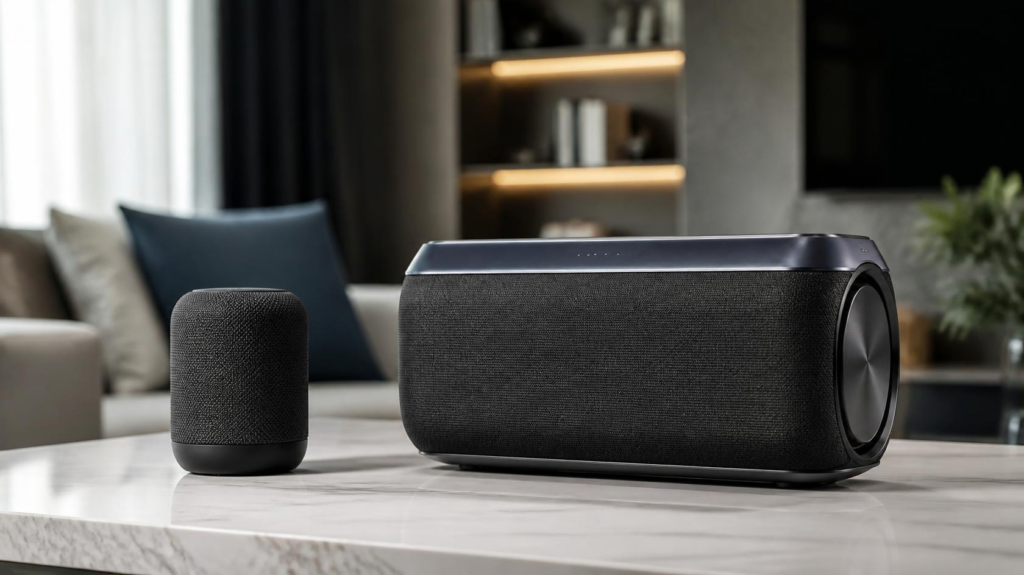
Bluetooth speakers range from compact models costing less than $50 to premium systems priced at $500 or more. With such a large difference in price, it is reasonable to wonder: Are expensive Bluetooth speakers worth it?
The answer depends on what you expect from your speaker.
More expensive models can deliver better sound quality, deeper bass, greater volume, improved build quality, and more advanced features. However, spending twice as much does not necessarily mean getting twice the performance. Once you reach a certain price point, improvements become smaller and increasingly dependent on how—and where—you listen.
Understanding what affects Bluetooth speaker sound quality can help you decide whether premium features are worth paying for or whether a less expensive speaker will give you everything you need.
The Short Answer
For many people, the best value is somewhere in the middle of the Bluetooth speaker market rather than at either extreme.
Budget Bluetooth speakers can be surprisingly capable for casual listening, travel, or background music. Moving into the $100–$200 range generally brings noticeable improvements in sound, bass response, maximum volume, battery life, and construction.
Beyond roughly $200, you increasingly pay for refinement: better acoustic engineering, more sophisticated DSP, larger or additional drivers, premium materials, ecosystem features, and stronger performance at high volume.
Premium Bluetooth speakers make the most sense for people who listen frequently, care about audio quality, need higher output, or want a speaker they can use for years.
Casual listeners who mainly want music in a bedroom, office, or small outdoor space may be better served by a good mid-range model.
What Makes a Bluetooth Speaker Expensive?
Bluetooth speaker price is influenced by far more than the logo printed on the front.
The drivers, amplifier, battery, enclosure, wireless hardware, software, acoustic engineering, materials, and manufacturing quality can all affect what a speaker costs to produce.
Brand reputation can also add to the price, which is why two speakers with similar specifications can sometimes have very different price tags.
Understanding Bluetooth Speaker Price Tiers
There is no official pricing system for Bluetooth speakers, but the market can roughly be divided into five categories.
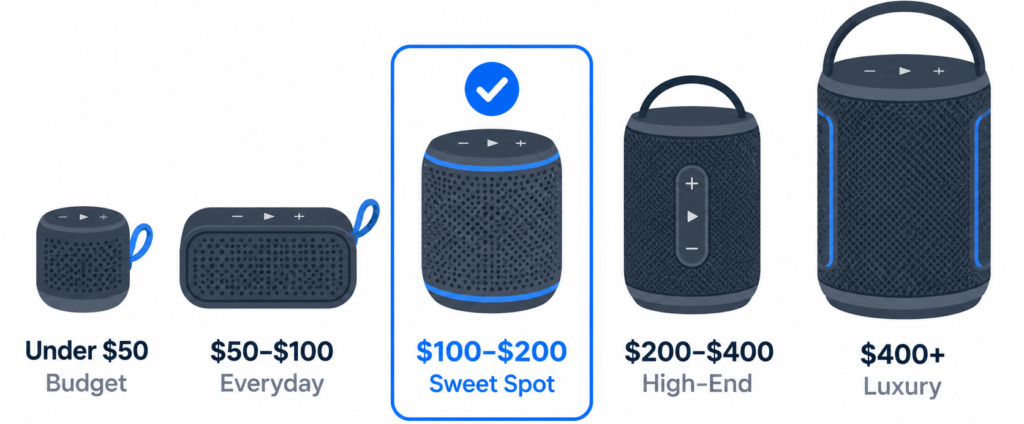
Budget Speakers — Under $50
Under $50, manufacturers have to make compromises.
These speakers are usually compact and may rely on one or two small drivers. Bass extension, maximum volume, battery capacity, and premium features are generally limited.
That does not make them bad products.
For podcasts, background music, travel, or occasional use, many inexpensive models provide excellent value. If that sounds closer to what you need, our Bluetooth speakers under $50 rankings are a better place to start than immediately shopping for a premium model.
Entry-Level Mid-Range — $50–$100
The $50–$100 category is where Bluetooth speakers become significantly more competitive.
You can find better bass, stronger battery life, waterproof construction, USB-C charging, app support, and enough volume for most everyday environments.
This category offers some of the strongest Bluetooth speaker value for money.
Premium Mid-Range — $100–$200
Between $100 and $200, manufacturers have more room to invest in better drivers, acoustic tuning, amplifiers, enclosure design, and DSP.
For many buyers, this is the sweet spot.
You can get a substantial improvement over entry-level speakers without entering the price range where diminishing returns become a major factor.
High-End Portable Speakers — $200–$400
High-end Bluetooth speakers commonly offer larger or more sophisticated driver arrangements, higher maximum output, stronger bass response, better construction, advanced app controls, and additional connectivity features.
The difference becomes particularly noticeable when listening loudly or filling larger spaces.
Luxury Bluetooth Speakers — $400+
At $400 and above, Bluetooth speakers can become as much about design, materials, brand positioning, and ecosystem integration as raw audio performance.
Some sound excellent, but price-to-performance becomes increasingly complicated.
A $600 speaker may sound better than a $200 speaker, but it is unlikely to sound three times better.
Where the Extra Money Goes
A higher Bluetooth speaker price can fund several improvements.
Better speaker drivers can reproduce sound with greater accuracy and less distortion. More powerful, higher-quality amplifiers can provide greater output while maintaining control. Advanced DSP can optimize frequency response and protect the drivers as volume increases.
Premium speakers may also use stronger enclosures, metal components, better fabrics, larger batteries, additional drivers, improved waterproofing, and more sophisticated wireless hardware.
Software matters too. Some manufacturers provide customizable EQ, firmware updates, multi-speaker pairing, multi-room audio, and other ecosystem features.
Premium Buyers vs Casual Users
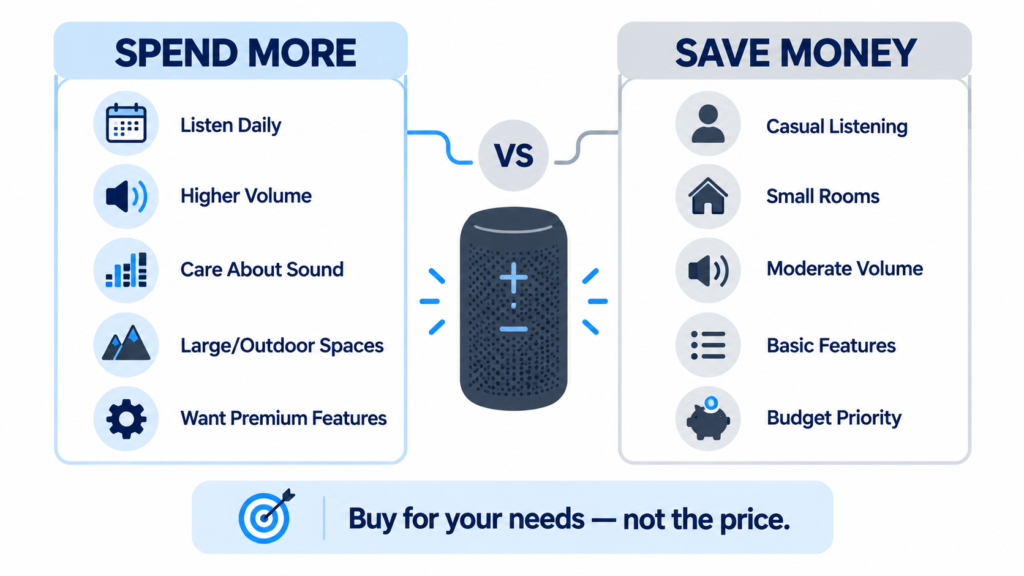
Someone who listens to music for several hours every day is more likely to appreciate a premium speaker than someone who occasionally plays music while cooking.
Spending more can make sense if you:
- Listen at higher volumes
- Want deeper and cleaner bass
- Use the speaker in large rooms or outdoors
- Care about vocal clarity and instrument separation
- Want premium materials and rugged construction
- Need advanced connectivity or ecosystem features
- Plan to keep the speaker for several years
If you mostly need background music in a small room, many of those advantages may provide little practical benefit.
Sound Quality Differences Across Price Ranges
Do expensive Bluetooth speakers sound better?
Often, yes—but not simply because they are more expensive.
Better speakers generally combine stronger hardware with more careful acoustic engineering. The difference may be subtle at low volume but much more noticeable when you increase the volume or listen to complicated music.
What Improves as Speakers Get More Expensive
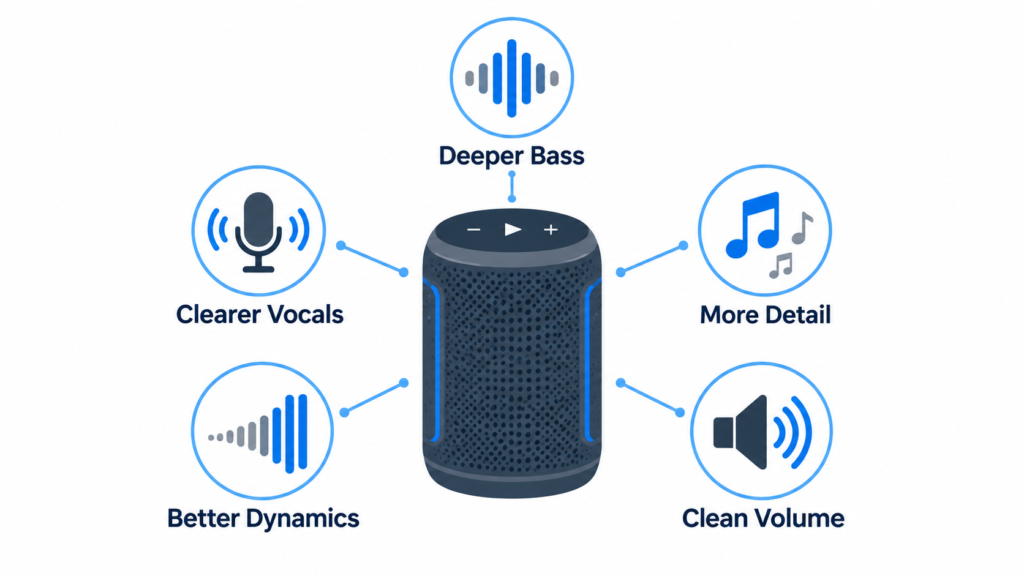
Bass Performance
Small speakers have physical limitations when reproducing low frequencies.
Premium models can compensate with larger drivers, dedicated woofers, passive radiators, stronger amplifiers, and more advanced DSP.
The result can be deeper bass with better definition rather than simply louder bass.
Vocal Clarity
Vocals occupy an important part of the midrange.
Poorly tuned speakers can make vocals sound recessed, muddy, harsh, or congested. Better speakers typically maintain clearer mids even when bass-heavy music is playing.
Instrument Separation
As arrangements become more complex, inexpensive speakers can struggle to keep individual sounds distinct.
A better-designed speaker can make it easier to distinguish vocals, drums, guitars, keyboards, and other elements instead of presenting everything as one crowded layer of sound.
Dynamic Range
Dynamic range describes the difference between quieter and louder parts of audio.
Better speakers can reproduce those changes with greater control, making music sound more lively and natural.
Maximum Volume
Larger and more powerful Bluetooth speakers can generally reach higher volume levels.
But maximum volume is only useful if the speaker remains clean.
A speaker that reaches 95 dB with obvious distortion is not necessarily better than one that plays slightly quieter while maintaining clarity.
Loudness vs Audio Quality
One of the easiest mistakes to make is assuming more power means better sound.
Bluetooth speaker wattage can contribute to available output, but wattage alone tells you surprisingly little about actual audio quality.
Speaker sensitivity, driver design, enclosure efficiency, DSP, amplifier performance, and room acoustics all matter. Our guide to Bluetooth speaker wattage explains why comparing watt numbers alone can be misleading.
Distortion is particularly important.
A budget speaker may sound perfectly acceptable at 40% volume but become harsh or compressed near its maximum output. A more capable speaker may maintain its tonal balance and clarity much farther up the volume range.
That difference can matter more than maximum loudness itself.
Can Average Listeners Hear the Difference?
Usually—but the size of the difference depends on the listener and situation.
A casual listener playing music quietly while working may notice very little difference between a competent $100 speaker and a $300 model.
An enthusiast listening carefully in a quiet room may immediately notice improved bass control, clarity, soundstage, and dynamics.
Audiophiles may notice even smaller differences, although people primarily interested in critical listening may eventually be better served by a dedicated stereo system rather than an increasingly expensive portable Bluetooth speaker.
Real-World Sound Quality by Budget
Under $50
Expect acceptable everyday audio with compromises in bass extension, maximum output, detail, and stereo separation.
$50–$100
This is where good mainstream performance becomes widely available. Many speakers offer enough volume and bass for bedrooms, offices, kitchens, and moderate outdoor use.
For many shoppers, our Bluetooth speakers under $100 rankings are still worth checking before moving upmarket because a well-chosen sub-$100 model may already satisfy your needs.
$100–$200
This range often provides the biggest balance between Bluetooth speaker audio quality and price. Bass becomes more convincing, output increases, and sound generally remains cleaner at higher volume.
$200–$400
Expect more powerful sound, improved bass extension, larger sound presentation, premium construction, and better high-volume performance.
$400+
Improvements continue, but diminishing returns become increasingly important. Design, materials, brand, Wi-Fi functionality, and ecosystem integration may account for more of the price.
The Technology Behind Better Sound
Specifications do not tell the whole story, but several technologies help explain why some premium Bluetooth speakers outperform cheaper models.
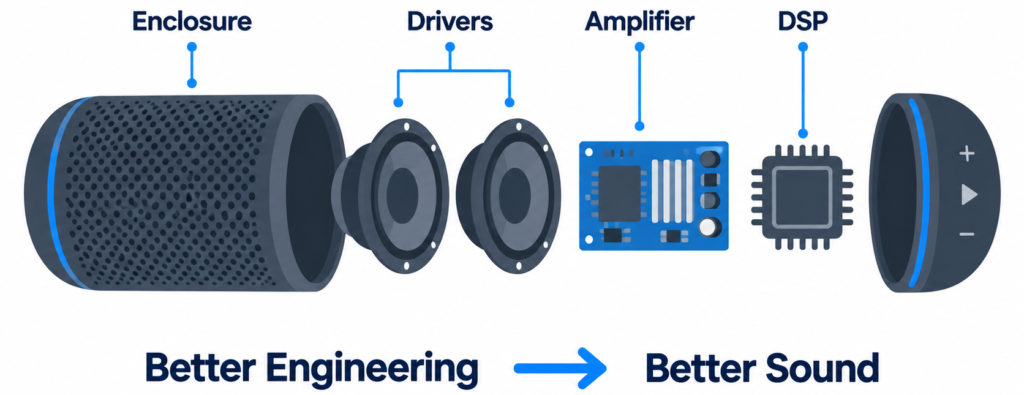
Driver Size and Configuration
A speaker driver converts electrical energy into sound.
Compact budget speakers commonly use full-range drivers designed to reproduce most of the audible spectrum.
More sophisticated speakers may divide that work among multiple drivers. A dedicated tweeter can handle higher frequencies while another driver focuses on mids and bass.
Multi-driver systems can improve clarity and frequency response, although the number of drivers alone does not determine quality. The crossover, enclosure, amplification, and tuning still matter.
Passive Radiators and Bass Enhancement
Passive radiators are common in portable Bluetooth speakers because they can increase low-frequency output without requiring a traditional bass port.
They respond to air pressure created by active drivers and can help a compact enclosure produce stronger bass than its size might suggest.
Their effectiveness depends heavily on how the entire system is engineered.
Amplifiers and Power Output
The amplifier provides power to the drivers.
More amplifier power can help produce greater volume and control, but efficiency and implementation matter as much as raw wattage.
A carefully designed 30-watt system can outperform a poorly engineered speaker advertised with a much larger number.
Digital Signal Processing (DSP)
DSP—digital signal processing—is one of the most important technologies in modern Bluetooth speakers.
Manufacturers can electronically adjust frequency response, bass, treble, dynamics, and driver behavior.
DSP can even change how a speaker behaves at different volume levels. Bass may be reduced near maximum volume, for example, to protect a small driver from excessive movement and distortion.
This is one reason two speakers with similar physical specifications can sound dramatically different.
Enclosure Design and Acoustic Engineering
The enclosure is not simply a box that holds the components.
Its dimensions, rigidity, internal volume, driver placement, sealing, and acoustic treatment can all affect the final sound.
This is one area where experienced audio manufacturers can gain an advantage without producing an obvious specification that appears on the box.
Bluetooth Performance and Connectivity
Audio quality is only part of the experience. A great-sounding speaker becomes frustrating if its wireless connection is unreliable.
Bluetooth Versions Explained
Bluetooth standards have continued to evolve, with Bluetooth 5.0, 5.2, 5.3, and newer versions appearing across modern speakers.
Newer implementations can provide improvements involving efficiency, reliability, and supported features.
However, you should not choose a speaker based solely on the Bluetooth version number. Actual range and stability depend on the entire wireless implementation as well as the source device.
Range, Stability, and Reliability
Premium Bluetooth speakers may use better antenna designs and wireless components, but price does not guarantee superior range.
Walls, interference, source-device quality, and other wireless devices can all affect performance.
For most buyers, connection stability is more important than achieving the maximum theoretical Bluetooth range.
Latency for Video and Gaming
Bluetooth introduces some amount of latency.
That may be irrelevant when listening to music, but noticeable when watching a video or playing a game because the sound can arrive slightly after the visual action.
Codec support, software, and the source device all influence latency.
Multipoint Connectivity and Device Switching
Bluetooth multipoint allows a speaker to maintain connections with more than one compatible device.
This can be useful if you regularly switch between a laptop and phone without wanting to disconnect and pair again.
It is a convenience feature rather than an audio-quality feature, but it can make a premium speaker easier to live with.
Audio Codec Support
Bluetooth codecs determine how digital audio is encoded and transmitted wirelessly.
Common options include SBC, AAC, aptX, aptX HD, and LDAC.
SBC
SBC is the standard Bluetooth audio codec and provides broad compatibility.
AAC
AAC is widely associated with Apple devices and is commonly supported across consumer audio products.
aptX
Qualcomm’s aptX family provides additional codec options on compatible devices.
aptX HD
aptX HD is designed to support higher-quality Bluetooth audio transmission than standard aptX, but both the source and receiving device must support it.
LDAC
Sony’s LDAC can operate at higher bitrates than standard Bluetooth codecs when supported by both devices and when connection conditions allow it.
How Much Codecs Actually Matter in Daily Use
Codec support matters, but it should not overshadow the physical speaker itself.
Excellent drivers and acoustic engineering using a standard codec can easily produce a better listening experience than mediocre hardware advertising a more advanced codec.
Your phone also needs to support the same codec.
For a deeper explanation of SBC, AAC, aptX, LDAC, compatibility, and bitrate, see Bluetooth audio codecs explained before paying extra specifically for codec support.
Durability, Build Quality, and Longevity
Premium Bluetooth speakers often feel noticeably different from inexpensive models.
But does better Bluetooth speaker build quality translate into longer life?
Sometimes.
Premium Materials vs Budget Construction
Budget speakers commonly rely heavily on plastic to reduce weight and manufacturing costs.
More expensive models may incorporate denser plastics, metal frames, aluminum components, reinforced rubber, higher-quality fabric, and more robust controls.
Premium materials do not automatically improve audio quality, but they can improve durability and the overall ownership experience.
Battery Lifespan and Long-Term Reliability
Lithium-ion batteries naturally lose capacity over time.
Battery longevity depends on cell quality, charging behavior, temperature, usage, and battery-management systems—not simply the initial purchase price.
A premium speaker may use higher-quality components, but no rechargeable battery lasts forever.
Internal Components and Quality Control
More expensive products may have tighter manufacturing tolerances and stronger quality-control processes.
However, this varies considerably between manufacturers.
Reputation, independent testing, owner reports, and warranty support are often more informative than price alone.
Warranty Coverage and Manufacturer Support
A premium price is easier to justify when it comes with good manufacturer support.
Before buying an expensive Bluetooth speaker, check warranty length, firmware support, replacement policies, and the availability of repair services.
Expected Lifespan by Price Category
There is no reliable rule saying a $300 speaker will last three times longer than a $100 speaker.
Build quality generally improves as you move beyond the cheapest products, but the relationship between price and lifespan becomes much weaker once basic quality reaches a good level.
Protection Against Water, Dust, and Drops
If you use your speaker outside, an IP rating can matter more than premium materials.
IP ratings describe specific levels of protection against solids and water. Depending on the model, this can range from basic splash resistance to designs capable of surviving temporary water immersion.
For camping, beaches, pools, and outdoor parties, rugged construction and an appropriate waterproof rating may be worth paying for.
Battery Life Expectations
Bluetooth speaker battery life varies enormously because speaker size, output, battery capacity, DSP, and listening volume all affect power consumption.
Typical Battery Life at Each Price Point
Budget speakers can offer impressive battery life because their small amplifiers and drivers consume relatively little energy.
Premium portable speakers often contain larger batteries, but they may also power more demanding hardware.
That means price alone is not a reliable predictor of runtime.
Manufacturer Claims vs Real-World Performance
Battery-life claims are generally measured under specific conditions.
Increasing the volume, boosting bass through EQ, charging another device, or using additional features can reduce real-world runtime.
Treat advertised battery life as a comparison point rather than a guarantee.
Charging Speed and USB-C Benefits
USB-C has made charging much more convenient, particularly if the speaker can share a charger with your phone, tablet, or laptop.
Some premium models also support faster charging.
For frequent travelers, charging convenience can be more valuable than a few additional hours of advertised battery life.
Battery Replacement and Repairability
One weakness of many modern Bluetooth speakers is limited repairability.
If the internal battery is difficult or impossible to replace, battery degradation can eventually determine the useful lifespan of an otherwise functional speaker.
For an expensive model you plan to keep for years, repairability and manufacturer support deserve consideration.
Features That Separate Premium Models From Budget Speakers
Premium Bluetooth speaker features can add genuine value—but manufacturers also know that a long feature list makes a product easier to market.
The important question is which features you will actually use.
Audio Customization and App Controls
Companion apps can provide customizable EQ, sound profiles, firmware updates, battery information, and additional controls.
EQ adjustment is particularly useful because listening preferences differ.
Some people want strong bass. Others prefer more neutral sound. An adjustable EQ can make one speaker work better for both.
Smart Features and Voice Assistants
Some speakers integrate with Alexa, Google Assistant, or broader smart-home platforms.
These features can be useful for a home Bluetooth speaker but are less important for a portable model primarily used outdoors.
Multi-Room and Wi-Fi Audio
Wi-Fi audio and multi-room capabilities can significantly change what a speaker can do at home.
Instead of relying exclusively on a direct Bluetooth connection, compatible systems can play synchronized audio across multiple rooms.
This is one reason premium ecosystem-oriented products can cost considerably more than conventional portable speakers.
If you are unsure which style better matches your needs, our comparison of portable vs home speakers explains the practical differences before you spend extra on features you may never use.
Stereo Pairing and Party Modes
Some manufacturers allow two identical speakers to operate as a stereo pair, while others support larger groups of synchronized speakers.
These features can be valuable if you intend to expand your setup later.
Power Bank Charging and Additional Utilities
Larger portable speakers sometimes allow their internal battery to charge your phone or another USB device.
It is not essential, but it can be useful during travel, camping, or power outages.
Features Worth Paying For
For most people, useful premium features include:
- Strong app and EQ support
- Reliable firmware updates
- Appropriate water and dust protection
- Good battery management
- USB-C charging
- Multipoint Bluetooth
- Stereo pairing
- Wi-Fi or multi-room support when used at home
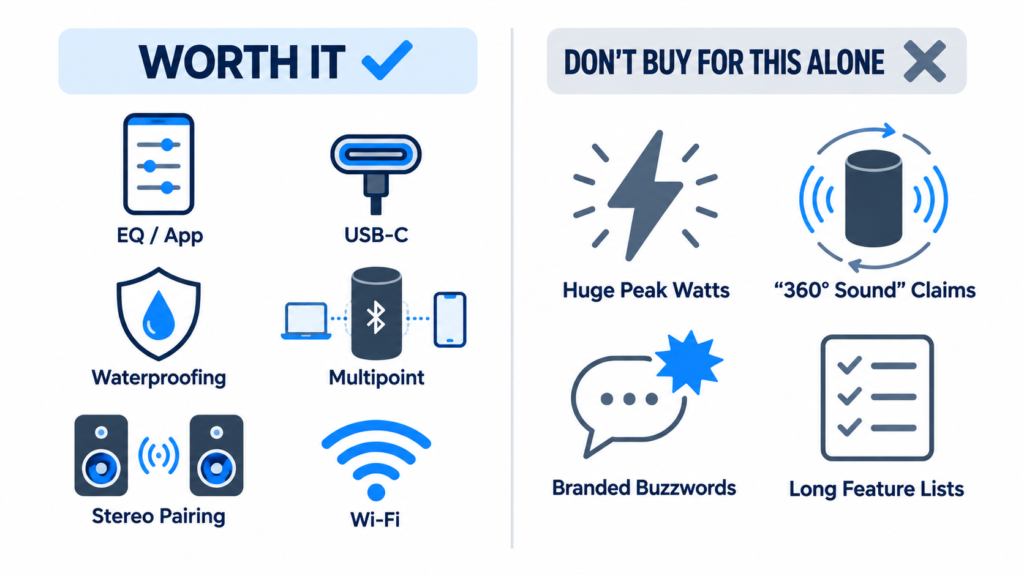
Features That Are Mostly Marketing Hype
Be cautious of features that sound impressive without providing measurable benefits.
Huge peak-power numbers, vague claims about “360-degree premium sound,” proprietary enhancement terminology, and extremely long lists of branded audio technologies do not automatically translate into better performance.
Listen to the results—not the marketing vocabulary.
Brand Value and Market Leaders
Brand matters, but it should be one factor rather than the deciding factor.
Different manufacturers tend to prioritize different aspects of the Bluetooth speaker experience.
JBL
JBL has an extensive range of portable Bluetooth speakers covering budget, mid-range, and premium categories.
Its strengths generally include portable designs, strong output, bass-forward tuning, rugged construction, and broad product selection.
The downside is that buyers have many similar models to compare, and moving higher in the lineup does not always make sense for every listener.
JBL is often strongest for shoppers seeking a balance of durability, output, portability, and value.
Bose
Bose typically focuses on polished consumer audio products with refined industrial design and accessible sound.
Its products can command a premium over competitors with similar basic specifications.
Whether that premium is justified depends on how much you value the overall design, tuning, usability, and brand ecosystem rather than raw specifications alone.
Sonos
Sonos becomes especially interesting for home listeners because its ecosystem extends beyond simple Bluetooth playback.
Multi-room audio, Wi-Fi connectivity, and integration with other Sonos products can add substantial value if you plan to build a larger home system.
If you only need one portable Bluetooth speaker, some of that ecosystem value may be irrelevant.
Sony
Sony offers Bluetooth speakers across several categories and frequently emphasizes powerful output, bass performance, and party-oriented features.
Its broad lineup makes it important to compare individual models rather than judge the entire brand as one category.
Ultimate Ears
Ultimate Ears has traditionally focused heavily on portable, outdoor-friendly speakers.
Its products can be attractive to buyers who prioritize portability, water resistance, simple controls, and rugged use.
Marshall
Marshall’s Bluetooth speakers stand out visually because of their styling.
The design itself is part of what buyers are paying for, particularly with home-oriented models. That does not make the premium inherently bad, but shoppers should decide how much aesthetic design is worth to them.
Harman Kardon
Harman Kardon commonly competes more heavily in stylish home-oriented Bluetooth audio.
These products may prioritize room-filling sound and design over maximum portability or outdoor durability.
Bang & Olufsen
Bang & Olufsen occupies the luxury end of the market.
Premium materials, industrial design, brand positioning, and craftsmanship contribute significantly to the price.
For buyers focused strictly on sound-per-dollar, less expensive alternatives may offer better value.
Anker Soundcore
Soundcore frequently competes aggressively on price-to-performance and features.
It can be particularly attractive to buyers who want strong app controls, EQ options, and modern features without paying the same brand premium associated with some high-end manufacturers.
Which Brand Delivers the Best Value?
There is no universal winner.
Value depends on whether you prioritize portability, sound quality, bass, durability, ecosystem features, design, or price.
Instead of choosing the brand first, identify your needs and compare individual products that satisfy them.
Side-by-Side Comparisons Buyers Search For
Comparing speakers within realistic price ranges makes the effect of spending more easier to understand.
Cheap vs Expensive Bluetooth Speakers
The biggest differences between cheap vs expensive Bluetooth speakers tend to involve bass extension, maximum clean volume, clarity, construction, and features.
At moderate volume in a small room, those differences can shrink considerably.
Move outside, increase the volume, or play demanding music and the advantages of a better speaker can become more obvious.
$50 vs $200 Bluetooth Speakers
Going from $50 to $200 can produce a meaningful improvement.
The $200 speaker may offer larger drivers, more output, stronger bass, better DSP, longer usable battery life, and improved durability.
This is the type of price jump where many listeners can hear and appreciate the difference.
$100 vs $300 Bluetooth Speakers
The difference between $100 and $300 is more complicated.
A good $100 speaker can already perform extremely well for casual use. The $300 model may improve bass depth, soundstage, high-volume clarity, construction, and premium features, but the value of those improvements depends heavily on your listening habits.
JBL Flip vs JBL Charge
Within JBL’s lineup, moving between families can affect more than sound.
Size, battery capacity, bass output, portability, and additional functionality can change as you move upward.
The smaller model may actually be the better purchase if portability matters more than maximum performance.
JBL Charge vs Bose SoundLink
Comparisons across brands are even less straightforward.
Instead of focusing only on price, compare size, tonal balance, battery performance, ruggedness, app functionality, and intended use.
The “better” speaker is the one that fits your priorities.
Sonos Roam vs JBL Charge
A Sonos product can make more sense for someone already invested in a compatible home ecosystem, while a JBL portable model may make more sense for someone primarily interested in straightforward Bluetooth playback and outdoor use.
Features have value only when you use them.
Bose vs Sony Bluetooth Speakers
Bose and Sony often approach the market differently depending on the product.
Rather than assuming one brand sounds better, compare specific models at similar prices and sizes.
Choosing the Right Speaker for Your Lifestyle
The best premium Bluetooth speakers are not necessarily the best speakers for everyone.
Your environment can matter just as much as your budget.
Home Listening
At home, portability and extreme waterproofing become less important.
Sound quality, Wi-Fi connectivity, multi-room features, design, and integration with other audio equipment may matter more.
Outdoor Parties and Events
Outdoor listening requires significantly more output because there are no walls to contain and reinforce the sound.
For parties and larger gatherings, additional amplifier power, larger drivers, stronger bass, and battery capacity can justify spending more.
Camping and Hiking
For camping, durability and battery life matter.
For hiking, weight becomes equally important.
A huge premium speaker may sound excellent at the campsite but become a burden if you have to carry it for several miles.
Travel and Portability
Frequent travelers should pay attention to physical dimensions, weight, charging options, and battery life.
The most expensive speaker is not necessarily the most convenient travel speaker.
College Students and Dorm Rooms
Dorm rooms generally do not require huge output.
A compact mid-range speaker with good sound, reliable Bluetooth, and USB-C charging may offer considerably better value than an oversized premium model.
Casual Music Listeners
If music is usually playing in the background, the differences between competent mid-range and premium Bluetooth speakers may not justify hundreds of dollars.
Audio Enthusiasts and Audiophiles
Enthusiasts are more likely to appreciate improved frequency response, soundstage, bass control, dynamics, and lower distortion.
However, there is eventually a point where someone primarily pursuing high-end audio should consider whether separate stereo speakers provide better performance for the money.
Finding the Best Value for Your Money
The key question is not whether expensive Bluetooth speakers are better.
It is whether the improvements are worth the additional money to you.
The Sweet Spot for Most Buyers
For many buyers, roughly $100–$200 represents an excellent balance.
This range is high enough for manufacturers to offer quality drivers, capable amplification, good battery life, durable construction, and useful software without entering the luxury market.
Where Diminishing Returns Begin
Diminishing returns occur when every additional dollar produces a smaller improvement.
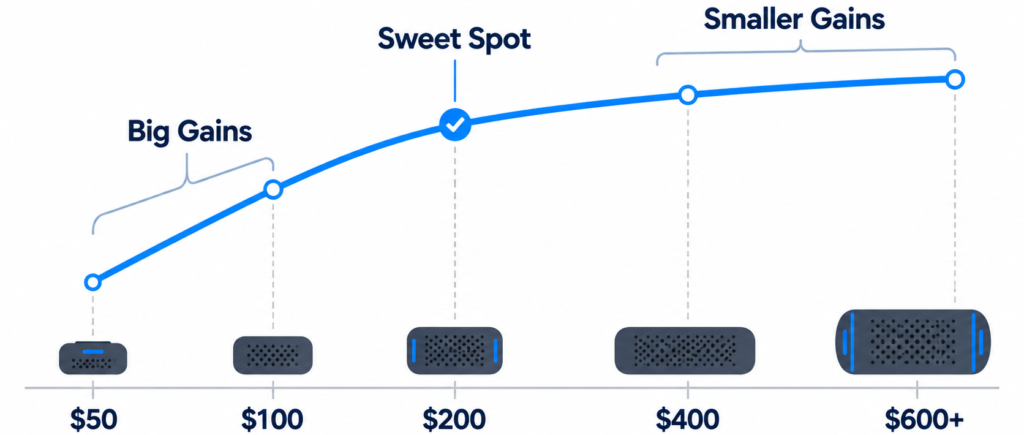
The jump from a $30 speaker to a $100 speaker can be dramatic.
The jump from $100 to $200 can still be significant.
The jump from $300 to $600 may be much more subtle and could involve premium materials, styling, or ecosystem features as much as pure sound quality.
There is no exact point where diminishing returns begin because products differ, but buyers should become increasingly critical as prices move beyond the mid-range.
Is $100 Enough?
For most casual listeners, yes.
There are plenty of capable speakers around $100 that offer strong everyday sound, useful bass, water resistance, good battery life, and enough output for normal listening.
Is $200 the Best Balance of Price and Performance?
For buyers who care more about sound, approximately $150–$200 can be an especially attractive range.
You can move beyond many of the limitations of budget hardware without paying luxury prices.
Are $500+ Speakers Worth the Investment?
Sometimes—but for a much narrower audience.
A $500+ speaker can make sense if it offers exceptional audio performance, premium construction, Wi-Fi and multi-room functionality, distinctive design, or integration with a system you already own.
If you are paying $500 strictly because you expect five times the performance of a $100 speaker, you will probably be disappointed.
If you’re ready to compare products at the upper end of the market, our high-end Bluetooth speakers rankings can help narrow down which premium models actually offer something meaningful for the extra money.
When Spending More Stops Making Sense
Spending more stops making sense when the improvements no longer affect how you actually use the speaker.
There is little value in paying for massive output if you listen quietly.
There is little value in advanced waterproofing if the speaker never leaves your desk.
And there is little value in multi-room connectivity if you only own and intend to use one speaker.
Buying Mistakes That Cost People Money
Premium vs budget Bluetooth speakers should be compared according to practical needs rather than marketing claims.
Several common mistakes can lead buyers to spend unnecessarily.
Paying for a Brand Name Alone
Brand reputation has value, especially when it comes to quality control and support.
But a recognizable logo does not automatically make a speaker better.
Compare performance and features instead of assuming the more prestigious brand wins.
Buying More Volume Than You Need
A powerful party speaker is unnecessary for quiet bedroom listening.
Consider the size of the spaces where you actually plan to use it.
Ignoring Size and Portability
Better bass and higher output often require larger hardware.
That $300 speaker may outperform a $100 portable model while also being much heavier and less convenient to carry.
Overlooking Battery Performance
Consider real-world battery life rather than only advertised maximum runtime.
If portability is important, a speaker that constantly needs charging can become frustrating regardless of how good it sounds.
Focusing Only on Bass
Strong Bluetooth speaker bass can be enjoyable, but excessive bass can overwhelm vocals and other frequencies.
Good sound is about balance.
Look for controlled bass, clear mids, detailed highs, and low distortion rather than simply choosing whichever product promises the most bass.
Forgetting About App Support and Updates
Apps can extend the usefulness of modern speakers.
EQ controls, firmware updates, pairing features, and configuration options can all improve long-term ownership.
Before paying a premium, check whether the manufacturer’s software is actually useful and actively supported.
How to Decide Whether an Expensive Bluetooth Speaker Is Right for You
Before buying, answer a few practical questions about how you will use it.
Your Listening Habits
How often do you listen?
Someone using a speaker every day will receive more value from an upgrade than someone using it once a month.
Also consider volume. Premium speakers tend to show more of their advantages as playback becomes louder and more demanding.
Your Budget
Set a realistic budget before shopping.
It is easy to start at $100 and gradually convince yourself that a $400 speaker must be dramatically better.
Instead, decide which features and performance improvements are actually worth paying for.
Indoor vs Outdoor Use
Outdoor environments generally require more volume and place greater importance on water resistance, battery life, and rugged construction.
Indoor listening can prioritize sound quality and connectivity.
iPhone vs Android Compatibility
Your phone can affect which wireless features you can use.
For example, codec support differs between devices and operating systems.
Check compatibility before paying extra for a specific wireless feature.
Feature Priorities
Make a short list of what you actually care about:
Sound quality?
Bass?
Portability?
Battery life?
Water resistance?
Maximum volume?
Multi-room audio?
App support?
This prevents less important features from influencing your decision.
Long-Term Ownership Considerations
Think beyond the first year.
Consider durability, firmware support, battery degradation, repairability, warranty coverage, and whether the speaker works within an ecosystem you might expand later.
If you still aren’t sure which specifications matter for your particular situation, our guide on how to choose the right Bluetooth speaker walks through the buying process in more detail.
Frequently Asked Questions
Are expensive Bluetooth speakers worth it?
Expensive Bluetooth speakers can be worth it if you care about better sound quality, deeper bass, higher clean volume, premium construction, advanced features, or long-term usability.
For casual listening, however, a good mid-range speaker can provide most of what you need for significantly less money.
What is the best Bluetooth speaker under $100?
The best option depends on whether you prioritize sound, portability, battery life, bass, or outdoor durability.
Rather than choosing based only on brand recognition, compare models designed for your intended use.
What is the best Bluetooth speaker under $200?
The $100–$200 range contains many compelling options because manufacturers have enough room to invest in better hardware without reaching luxury pricing.
Look for balanced sound, low distortion, appropriate output, strong battery performance, and the features you will actually use.
Do expensive Bluetooth speakers last longer?
Not automatically.
More expensive models may use better materials, components, and quality-control standards, but batteries still degrade and electronics can fail.
Warranty coverage, construction, repairability, and manufacturer support are more useful indicators than price alone.
Is Bose better than JBL?
Neither brand is universally better.
JBL often emphasizes rugged portable designs, output, and value, while Bose may prioritize polished tuning, design, and user experience.
Compare specific products rather than brands as a whole.
Is Sonos worth the money?
Sonos can be especially valuable for people who want Wi-Fi audio, multi-room playback, and an expandable home ecosystem.
Someone who only wants a simple portable Bluetooth speaker may not benefit from those advantages.
Why are some Bluetooth speakers so expensive?
Premium Bluetooth speakers can cost more because of better drivers, amplifiers, DSP, enclosure engineering, batteries, materials, wireless technology, software development, and manufacturing quality.
Brand positioning and design can also contribute significantly to the final price.
Can you hear the difference between cheap and expensive speakers?
Often, yes.
Differences may include deeper bass, clearer vocals, improved instrument separation, greater maximum volume, and less distortion.
The difference tends to become more noticeable at higher volumes and in more demanding listening environments.
What is the best Bluetooth speaker for outdoor use?
Outdoor speakers should have enough output for an open environment, appropriate water and dust resistance, strong battery life, and rugged construction.
Portability also matters if you plan to carry the speaker frequently.
At what price do Bluetooth speakers stop getting better?
There is no universal cutoff.
Sound can continue improving at higher prices, but the improvements generally become smaller. For many mainstream buyers, the biggest performance gains occur when moving from budget models into the mid-range.
Above a few hundred dollars, paying more may increasingly buy refinement, materials, design, ecosystem features, and specialized performance rather than dramatic improvements in everyday listening.
Final Verdict
So, are expensive Bluetooth speakers worth the money?
Sometimes—but you do not need an expensive speaker simply to get good sound.
The largest improvements usually happen when moving away from extremely cheap hardware into a well-designed mid-range model. Better drivers, stronger amplification, more sophisticated DSP, improved enclosures, larger batteries, and higher-quality construction can produce real benefits.
But those benefits do not increase proportionally with price.
Best Choice for Most People
Most buyers should focus on the mid-range.
A well-designed speaker around $100–$200 can provide excellent sound, useful bass, sufficient volume, good battery life, and durable construction without entering the high-end market.
Best Choice for Sound Quality Enthusiasts
If sound quality is one of your main priorities and you regularly listen at moderate or high volumes, moving into the $200–$400 range can make sense.
Look for genuine improvements in driver design, frequency response, bass extension, distortion, DSP, and acoustic engineering rather than premium branding alone.
Best Choice for Budget Buyers
You do not have to spend hundreds of dollars to get a good Bluetooth speaker.
Modern budget and mid-range models can provide excellent everyday performance, particularly in smaller rooms and at moderate listening levels.
When Premium Speakers Are Worth Every Penny
A premium Bluetooth speaker is easiest to justify when you will actually take advantage of what makes it premium.
If you listen every day, care about audio quality, need powerful clean output, want better construction, or value features such as multi-room audio and advanced app controls, spending more can substantially improve the experience.
When You Should Save Your Money
Save your money if you mainly use a speaker for casual background listening, do not need high volume, rarely take it outside, and are unlikely to use advanced features.
The goal should not be to buy the most expensive speaker you can afford.
It should be to find the point where sound quality, features, durability, and price match the way you actually listen.
Once you reach that point, spending more is no longer automatically an upgrade—it is simply spending more.